What is RFID technology and how does it work?
RFID stands for Radio-Frequency Identification - a
wireless
technology that uses radio waves to
automatically identify and track tagged objects (for example life vests). Each RFID
tag
contains a tiny
chip and antenna that stores data (serial number, expiration date, etc.). When it
comes
near an RFID
reader, the reader’s radio signal powers the tag and the tag sends its information
back
to the reader
without any physical contact. This allows for quick, automatic identification of
items
from a distance.
How is RFID used in the aviation industry?
Airlines use RFID in many ways to boost efficiency and
safety. For example, RFID tags on safety
equipment (like life vests or oxygen masks) are tagged so maintenance crews can
easily
monitor stock
levels, check expiration dates, and ensure everything is in place and up-to-date.
RFID
is also used for
security (badges controlling access to restricted areas) and even speeding up
boarding
with RFIDenabled boarding passes, improving the overall passenger experience.
How does RFID differ from barcode scanning?
RFID does not require direct line-of-sight to the item,
whereas barcode scanners must “see” each
barcode one by one. An RFID reader can scan dozens of tags at once, even if they’re
hidden or
embedded in equipment, making it much faster for tasks like life vest checks. RFID
tags
can also hold
more data and are often more durable (no printed label to wear out), while barcodes
are
simple visuals
that can be damaged or dirty. In short, RFID enables bulk, remote scanning, whereas
barcodes require
manual, close-up scanning of each item.
Does RFID require line of sight to work?
No. RFID tags can be read without line of sight - the
reader
uses radio waves that penetrate materials
like plastic or fabric. This means a crew member can walk through the cabin with a
scanner and detect
tags under seats or inside compartments without having to visually find each item.
This
is a big
advantage over technologies like barcodes, which would need a direct view of each
label.
How accurate is RFID scanning compared to visual
inspection?
RFID scanning is extremely accurate and far less prone to
human error than a visual check. Manual
inspections can miss items or lead to recording mistakes, but RFID automates the
process
and ensures
every tagged item is accounted for. In practice, RFID systems will alert staff if
any
required equipment is
missing or expired, providing near 100% verification of safety gear. By removing the
guesswork and
fatigue that come with visual checks, RFID makes inspections more reliable.
Why is RFID better than manual safety equipment checks?
RFID makes safety inspections much faster and more
reliable
than manual checks. Airlines have reported
cutting inspection times by as much as 95% by using RFID - a task that once took
over an
hour can be
done in just minutes. Because the scanner instantly reads all equipment tags,
nothing
gets overlooked
and human error is greatly reduced. The process also automatically logs the results,
so
there’s less
paperwork and more confidence that every life vest has been properly checked.
What types of safety equipment can be tracked with RFID?
Virtually any onboard safety item can be RFID-tagged and
tracked. Common examples include life vests,
life rafts, fire extinguishers, and oxygen tanks/bottles. Airlines also use RFID for
equipment like
emergency medical kits or defibrillators to ensure they are present and serviceable.
In
short, all crucial
emergency and safety equipment - from under-seat flotation devices to portable
oxygen
units - can
carry RFID tags so their status is monitored at all times. * Note that at this time
CabinTrack can only be
used to track life vests - in the future we are planing to expand the list of
emergency
equipment that can
be tracked.
How durable are RFID tags in an aircraft environment?
RFID tags used on aircraft are built to be very durable
and
meet strict aviation standards. Engineers
design these tags to withstand extreme temperatures, pressure changes at altitude,
vibration, and the
general wear-and-tear of cabin service. The tags are often sealed or reinforced so
they
remain readable
for many years. In the demanding environment of flight, specialized RFID tags ensure
reliability without
interfering with aircraft systems.
What maintenance do RFID tags require?
Typically, RFID tags require little to no maintenance.
Most
tags used for cabin equipment are passive -
they have no battery - so there’s nothing to replace. Once a tag is attached to an
item,
it can last for the
life of the equipment, only needing attention if it becomes damaged or detached. In
practice,
maintenance staff may occasionally verify that tags are still securely in place and
readable, but the tags
themselves don’t need regular servicing or power.
Can RFID technology be used beyond safety equipment checks?
Yes. RFID is a versatile technology that extends far
beyond
safety gear inspections. Airlines use RFID to
track many other assets - for example, tool kits and spare parts can be tagged so
maintenance crews can
quickly locate and manage them. It’s also used for inventory like catering supplies
or
cleaning
equipment, ensuring those items are where they should be. RFID technology has proved
its
effectiveness in aviation industry for years.
Can CabinTrack work offline?
Yes. CabinTrack is designed to work even when you don’t
have
an internet connection in the aircraft.
The handheld scanner can perform RFID scans offline, storing inspection data locally
during the flight or
while at a remote location. Once a connection is available, the system securely
syncs
the data to the
central CabinTrack platform. This means safety checks can be carried out anywhere,
anytime. * Note
that some specific scan types using CabinTrack requires Internet connection.
Can CabinTrack integrate with airline maintenance software?
CabinTrack can share data with your existing maintenance
and
record-keeping systems so that
everything stays in sync. In practice, this means you don’t need to manually
re-enter
data; CabinTrack
can automatically update your central maintenance system (such as an MRO or
compliance
database)
with the latest inspection info. * Requires consultation.
How quickly can RFID-based inspections be implemented?
RFID inspections can be up and running quickly. Tagging
the
cabin equipment is straightforward and can
be done during routine maintenance or overnight stops without taking aircraft out of
service. Most of
the life vests already have RFID tags on them, fitted by the manufacturer, other
need
separate tagging.
Some airlines fitted their first RFID-enabled aircraft in just a few months and then
rolled the system out
fleet-wide within the year. Once the equipment has RFID tags and the CabinTrack
system
is set up,
crews can begin using it almost immediately - the switch from manual checks to RFID
scanning is swift
and causes minimal disruption.
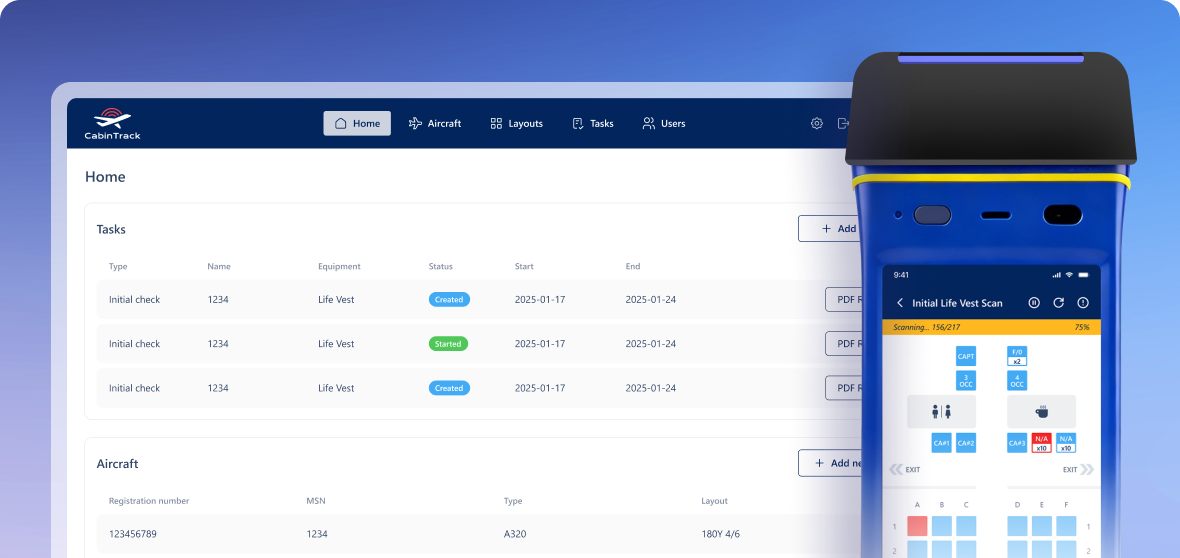
What hardware is needed for RFID scanning?
The essential hardware includes RFID tags on the items
and an
RFID reader device for scanning.
CabinTrack uses small, passive RFID tags attached to each piece of safety equipment.
A
handheld RFID
scanner is then used to sweep over the cabin and detect those tags. Other than the
tags
and reader, the
rest is software - the CabinTrack app - which guides the user during inspections.
The
hardware is
lightweight and portable, making it easy for crew or engineers to carry out checks
anywhere on the
plane.
What training is needed to use CabinTrack?
Very minimal training is needed. CabinTrack is built to
be
user-friendly, with an intuitive app interface
and simple scanning process. Most crew or maintenance staff can learn to use the
handheld RFID
scanner and CabinTrack software in a short session - essentially, if you can use a
smartphone or a
barcode scanner, you can use CabinTrack. We also provide supporting resources, but
in
practice the
system is straightforward enough that teams can get comfortable with it quickly.
How secure is RFID data in aviation?
RFID data can be made very secure. The CabinTrack system
and
RFID tags do not broadcast sensitive
information openly - typically, a tag might only contain an ID number, and all the
detailed data is stored
in a secure database. The communication between RFID readers are access-controlled,
so
that only
authorized devices and personnel can read or update the data. In short, the RFID
solution uses various
security measures to protect the information, ensuring that safety equipment records
are
safe from
tampering or unauthorized access.
How does RFID help with regulatory compliance?
RFID creates a reliable digital audit trail for safety
checks, which makes regulatory compliance much
easier. Every inspection and item status is logged automatically, so airlines can
easily
prove that all
required equipment has been checked and is within its expiration date. The system
flags
any missing or
expired items instantly, helping maintenance crews fix issues before a flight
departs.
By reducing the
chance of human error and missed inspections, RFID greatly lowers the risk of
non-compliance with
safety regulations. Overall, it gives regulators and airlines confidence that
nothing
has been overlooked,
and it simplifies the paperwork needed to demonstrate compliance.
What’s the return on investment for RFID inspections?
The return on investment for RFID-based inspections is
typically very strong. By saving countless labor
hours (for example, turning hours of manual work into minutes of scanning) and
avoiding
flight delays or
cancellations due to overlooked equipment, the system pays for itself quickly.
Airlines
see financial
benefits from reduced maintenance time, fewer errors (which means less rework or
fines),
and better
aircraft utilization. In many cases, RFID solutions like CabinTrack deliver a rapid
ROI
because they
streamline operations and prevent costly compliance issues, all while improving
safety
assurance.
How does RFID contribute to sustainability in aviation?
RFID can help airlines operate more sustainably in a few
ways. First, it enables more efficient use of
safety equipment - by tracking expiration dates and usage, airlines can use items to
their full life and
reduce unnecessary waste (for example, not discarding life vests too early or
carrying
extra equipment
“just in case”). Second, RFID inspections are largely digital, which cuts down on
paper
checklists and
manuals, contributing to a paperless cabin and less waste. Additionally, smoother
and
faster inspections
can indirectly support sustainability by reducing engine idling time on the ground
(since delays are less
likely) and optimizing maintenance schedules. All these factors mean RFID solutions
like
CabinTrack not
only save time and money but also support greener operations through waste reduction
and
improved
efficiency.